What is the Difference between Screen and Hand Block Printing?
Quick answer: Hand block printing uses hand-carved wooden blocks that are dipped in dye and stamped onto fabric one motif at a time, while screen printing uses a fine mesh stencil to push ink through onto the fabric in a single pass per colour. Hand block printing is slower, entirely manual, and produces subtle natural variation, while screen printing is faster, more uniform, and generally more affordable at scale. Aarav Collection specialises exclusively in authentic hand block printing across our Jaipur-manufactured sarees and suits.
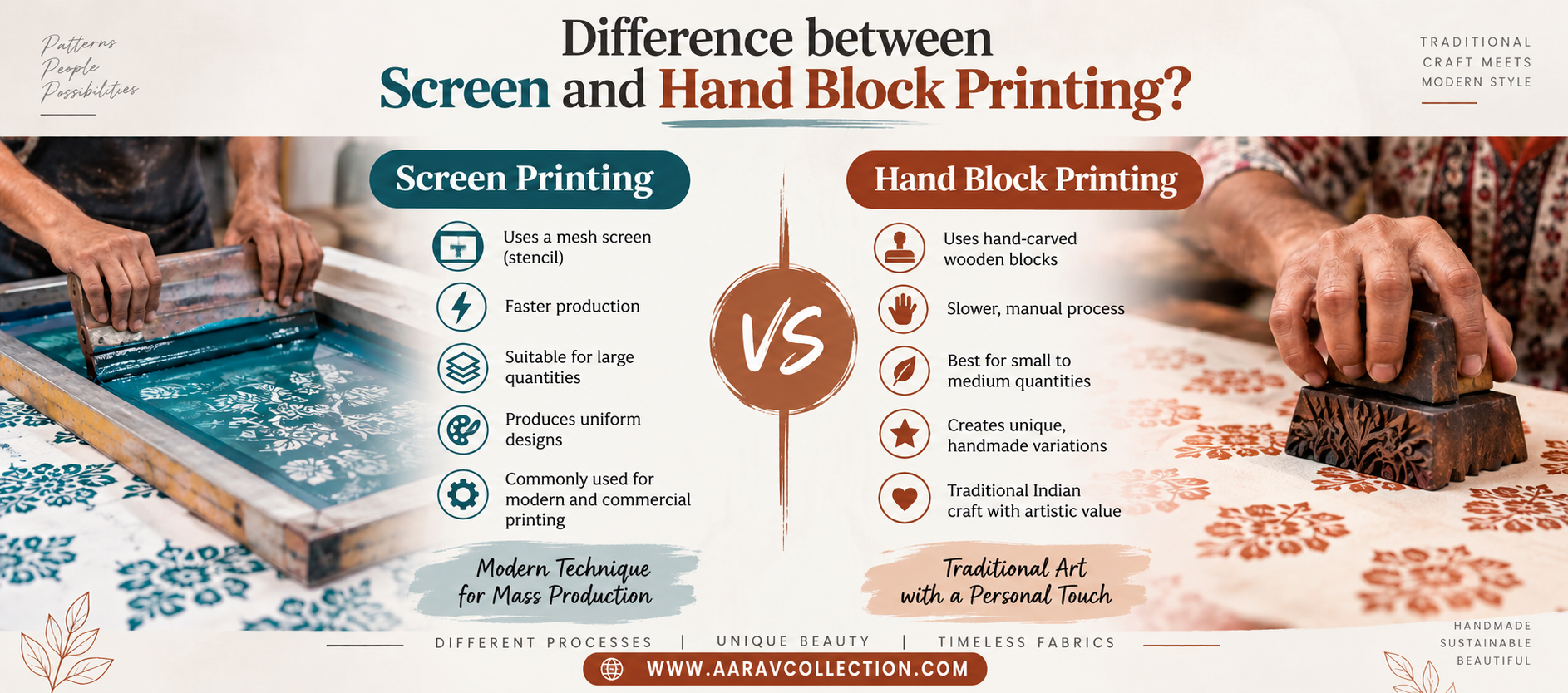
The purpose of printing fabric is mainly to make it visually appealing, and several techniques are used across the industry to achieve this. Hand block printing and screen printing are two of the most common, and while people often confuse the two, the tools, process, and final result are quite different. You can see the results of authentic hand block printing across our hand block print sarees and unstitched hand block print cotton salwar suits collections.
Hand Block Print vs Screen Print: Side-by-Side Comparison
| Factor | Hand Block Printing | Screen Printing |
|---|
| Core tool | Hand-carved wooden block | Mesh stencil ("screen") |
| Process | Stamped by hand, one repeat at a time | Ink pushed through stencil per colour pass |
| Speed | Slow, entirely manual | Fast, suited to high volume |
| Finished look | Small natural variation, slightly raised texture | Flat, perfectly uniform repeat |
| Cost at scale | Higher, due to manual skilled labour | Lower per piece at volume |
| Best suited for | Artisanal, heritage, premium positioning | Budget, high-volume production |
An Age-Old Craft vs a Modern Technique
Hand block printing is centuries old, while screen printing is a comparatively modern industrial technique. The tools alone tell the story: hand block printing uses carved wooden blocks, soaked in oil overnight to soften the grain before use, while screen printing relies on a stencil, or "screen," to transfer the design onto fabric. If you'd like to see every tool behind hand block printing in detail, our block printing supplies guide and tools guide cover this fully.
In hand block printing, wooden blocks carved with the design are dipped in dye and stamped by hand, one repeat at a time, down the length of the fabric — a process our Chanderi hand block print suit manufacturing follows closely. Screen printing instead stretches a fine mesh (traditionally silk, now often synthetic) over a frame, coats it with a design stencil, and pushes ink through the open areas onto the fabric below.
The finished look differs too: screen prints tend to look clean, flat, and highly uniform, which also makes them cheaper to produce at volume. Hand block prints, made by our Chanderi hand block print saree artisans, carry small natural variations from stamp to stamp that give each piece a distinctly artisanal, one-of-a-kind character. Because it is done entirely by hand, one hand block printed piece typically takes considerably longer to produce than the same design screen printed. If you're buying rather than manufacturing, our guide on spotting authentic hand block print covers the same visual cues from a buyer's perspective.
Common Hand Block Printing Techniques
- Discharge printing: The fabric is first dyed a base colour, then a chemical is applied to selectively bleach specific areas before a different colour is reapplied, creating a layered effect.
- Direct printing: The fabric is bleached first to improve dye absorption, dried, and then printed directly with dye-loaded blocks.
- Resist printing: A resin-and-clay paste is applied to areas that should stay undyed before colour is added to the rest of the fabric, leaving crisp, protected outlines — the same principle behind traditional Ajrakh printing.
Screen printing, by contrast, uses only one core method: coating the fabric with ink pushed through a stencil, then leaving it to dry so the design sets. For the full step-by-step hand block process from start to finish, see our post on how to block print.
Frequently Asked Questions (FAQ)
Q1: Which technique is more expensive, hand block printing or screen printing?
Hand block printing is generally more expensive because it is a slower, entirely manual process requiring skilled artisans, while screen printing can be produced faster and at larger volumes, lowering the per-piece cost.
Q2: Can I tell hand block print and screen print apart by looking at the fabric?
Yes, usually. Hand block prints show small natural variations in alignment and colour depth between repeats along with a slightly raised texture, while screen prints look perfectly flat and uniform across the entire length of fabric.
Q3: Is hand block printing always better than screen printing?
Not necessarily better, but different. Hand block printing offers artisanal character, heritage value, and small production runs, while screen printing suits high-volume, budget-conscious orders where perfect uniformity matters more than handcrafted variation. The right choice depends on your product positioning and target customer.
Q4: Does Aarav Collection use screen printing, or only hand block printing?
Aarav Collection specialises exclusively in authentic hand block printing across our sarees and salwar suits, produced by artisans in Jaipur using traditional wooden blocks rather than screen printing methods.
Q5: Does Aarav Collection manufacture hand block printed sarees and suits?
Yes, we manufacture and wholesale hand block printed sarees and salwar suits, including Chanderi varieties, using traditional wooden block printing techniques from our Jaipur facility.