Hand Block Print vs Machine Print: How to Spot an Authentic Saree
Quick answer: Hand block printed sarees are stamped one motif at a time using hand-carved wooden blocks, which leaves small, natural irregularities, a faint raised texture, and slight colour variation between repeats. Machine or screen-printed sarees show a perfectly uniform, flat pattern with no texture and identical repeats from end to end. The five checks below — texture, repeat pattern, back-of-fabric bleed, smell, and price — will help you (or your customers) tell the two apart in seconds.
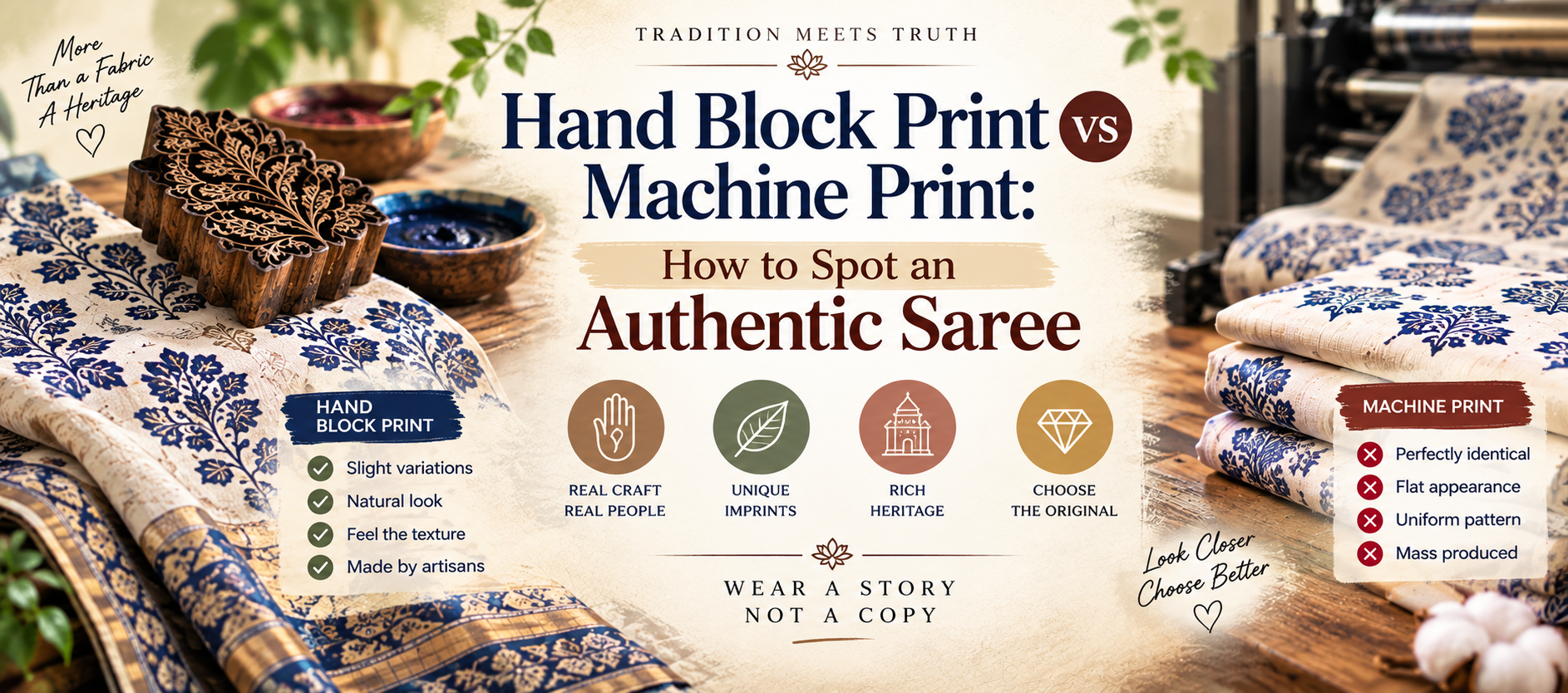
The 5 Checks at a Glance
| Check | Genuine Hand Block Print | Machine / Screen Print |
|---|
| Texture | Slightly raised where dye is stamped | Flat, sprayed or rolled on |
| Repeat pattern | Small natural variation between repeats | Mathematically identical, zero variation |
| Reverse side | Colour often shows through faintly | Back usually stays plain or white |
| Smell / first wash | Faint earthy smell, slight colour release | Flat, "inky" chemical smell, no release |
| Price point | Higher, reflecting manual craftsmanship | Lower, mass-produced |
1. Feel the Texture
Run your fingers over the printed area. Genuine hand block printing leaves a very slight raised feel where the wooden block has pressed dye or resist paste into the weave. Machine and digital prints sit flat on the surface of the fabric because the colour is sprayed or rolled on rather than stamped.
2. Study the Repeat Pattern
Look closely at where one motif ends and the next begins. In hand block work, you will notice tiny inconsistencies — a slightly shifted alignment, a faint double-stamp mark, or minor colour depth changes row to row. This is the signature of human hands repositioning a block thousands of times. A machine-printed saree will have a mathematically identical, seamless repeat with zero variation. Our post on hand block print vs screen print covers the tooling behind this difference in more depth.
3. Check the Reverse Side
Turn the fabric over. On authentic hand block prints, especially with natural or reactive dyes, the colour typically shows through faintly on the back of the cloth because the dye is pressed and absorbed into the fibres. Machine prints usually stay only on the surface, so the back remains largely plain or white.
4. Natural Dye vs Synthetic Smell and Bleed Test
Natural-dyed hand block prints (like traditional Ajrakh or indigo work) sometimes carry a faint earthy or vegetable-dye smell when new, and a damp white cloth rubbed gently on the print may release a very small amount of colour on the very first wash. Heavily synthetic, mass-printed fabric rarely shows this and instead has a flat "inky" chemical smell. See our care guide for how to handle that first wash properly.
5. Compare the Price Point
Because of the time, skilled labour, and multiple dyeing stages involved, genuine hand block printed sarees — whether cotton hand block printed sarees, Chanderi hand block printed sarees, or Kota Doria sarees — are priced higher than mass-produced, machine-printed alternatives of similar-looking design. If a "hand block printed" saree is priced the same as a digitally printed one, that is usually a red flag. To understand exactly what goes into that price, see our guide to block printing supplies and process.
Why This Matters for Your Business
If you are a boutique owner, exporter, or reseller, sourcing genuinely hand block printed stock protects your brand's credibility and lets you charge for the craftsmanship your customers are actually paying for. At Aarav Collection, every saree we manufacture and wholesale is produced using authentic hand block printing techniques from our Jaipur workshops, so what you see in our catalogue is exactly what reaches your customer.
Frequently Asked Questions (FAQ)
Q1: Does a slightly uneven print mean the saree is low quality?
No, the opposite. Minor irregularities in a hand block printed repeat are a natural result of the manual stamping process and are considered proof of authenticity rather than a defect.
Q2: Can hand block prints be washed like normal fabric?
Yes, with a little extra care. Hand block printed sarees, especially those with natural dyes, should ideally be washed separately in cold water for the first few washes to allow any excess colour to settle, and dried in shade rather than direct sunlight.
Q3: What's the single easiest check to do before buying online, without touching the fabric?
Zoom into a close-up photo of the print and compare two repeats of the same motif side by side. If they are pixel-for-pixel identical with no variation at all, it's very likely machine printed rather than hand block printed.
Q4: Does Aarav Collection use natural or synthetic dyes for its hand block printed sarees?
We use a mix of both depending on the design: natural dyes for traditional styles like Ajrakh and Bagru-inspired prints, and reactive dyes for designs that call for a wider, more vivid colour range. Both are applied using genuine hand block printing, never machine or screen methods.
Q5: Where can I buy genuine hand block printed sarees in wholesale quantities?
Aarav Collection manufactures and wholesales a wide range of authentic hand block printed sarees, including cotton, Chanderi, Kota Doria, and Ajrakh varieties, directly from our Jaipur facility. Contact us for catalogues and bulk pricing.